How Much Does Commercial Holiday Decorating Cost? A 2026 Budget Guide for Hotels & Businesses
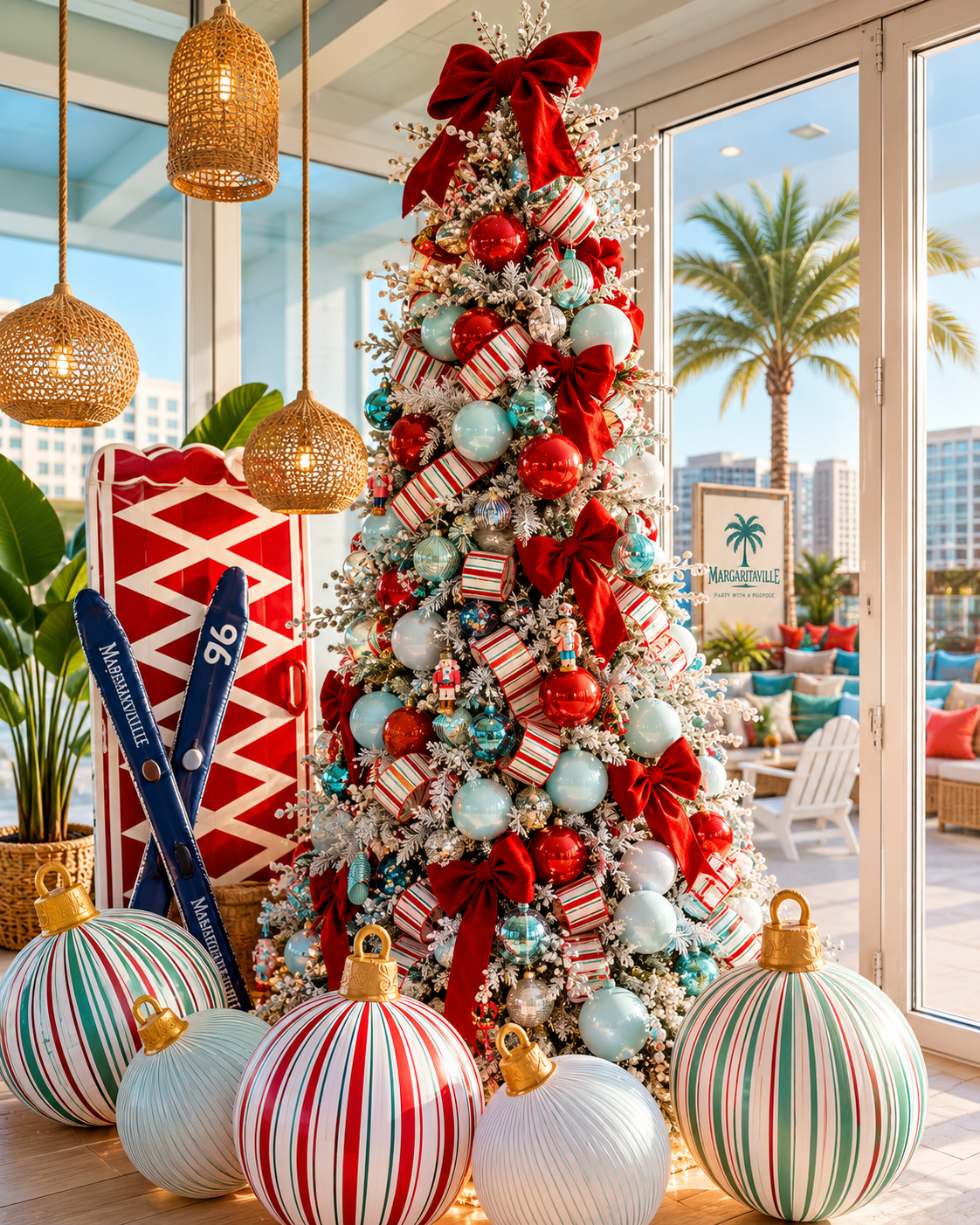
Margaritavillle Nashville
One of the questions we hear most often during holiday planning is also one of the hardest to answer in a single number:
“What should we actually budget for holiday décor?”
The short answer is: it depends.
A beautifully designed restaurant entrance, a hotel lobby holiday program, and a fully immersive seasonal activation are three completely different projects. The amount of décor matters, of course, but so do installation logistics, custom fabrication, lighting, storage, labor, access, and how many areas of a property you’re trying to transform.
That said, I don’t think it’s particularly helpful to tell clients that pricing simply “varies.”
So here is a realistic look at what different commercial holiday budgets can accomplish — and how we think about making every dollar work as hard as possible.
What does professional commercial holiday decorating typically cost?
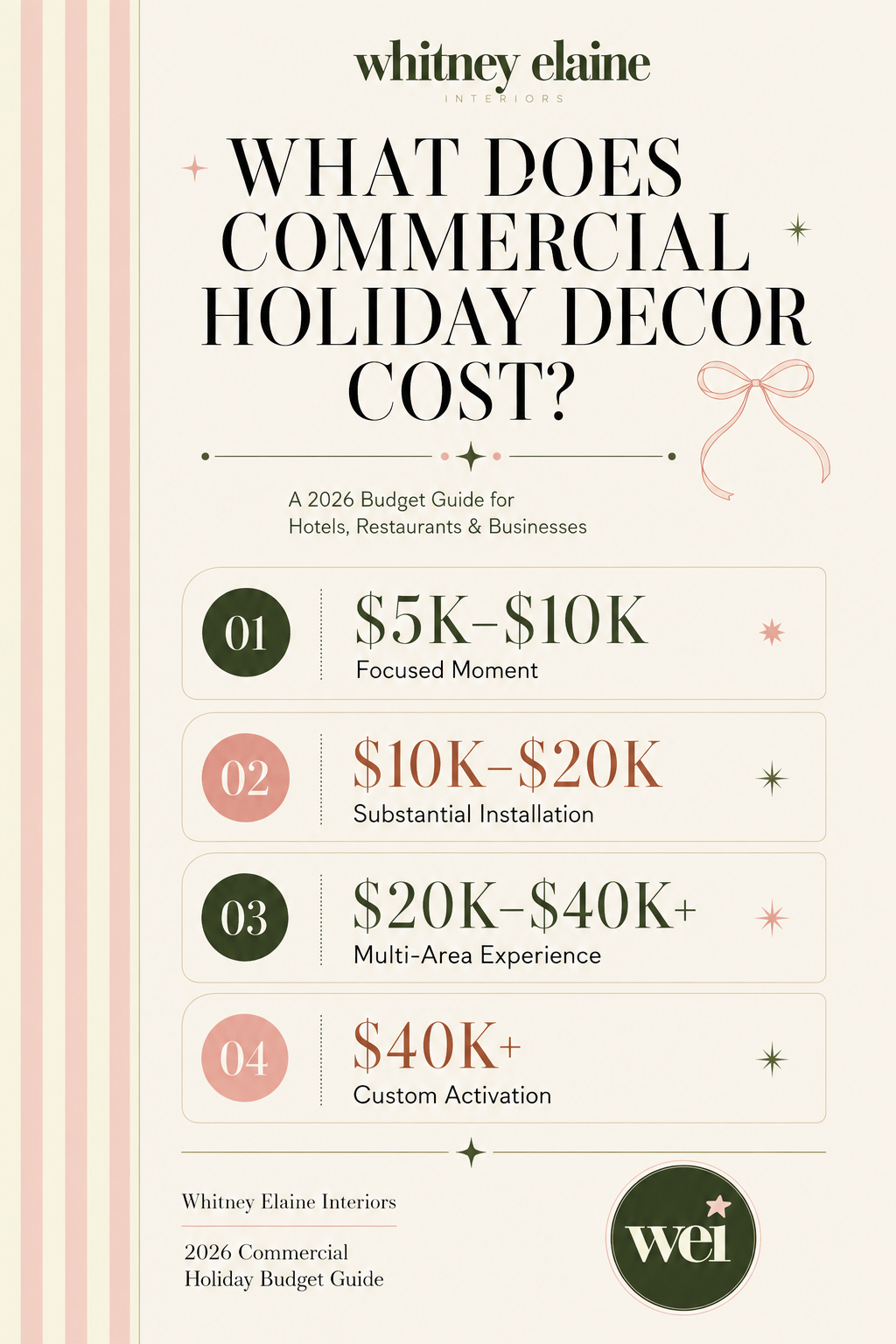
2026 commercial holiday decor cost guide for hotels, restaurants and businesses, with budget ranges from $5K to $40K+ by Whitney Elaine Interiors.
For hospitality and commercial properties, we generally see holiday programs fall into a few broad investment ranges.
$5,000–$10,000: A focused seasonal moment
This range is best for a smaller commercial space or a property that wants to concentrate its budget in one high-impact area.
That might include:
One professionally designed statement tree
A strong entrance or arrival moment
Garland and greenery around one architectural feature
A restaurant or bar focal point
Styling an existing collection with new pieces and updated details
The key at this level is focus.
Rather than spreading the budget across an entire property and having everything feel a little underwhelming, we would usually recommend choosing the one or two places guests will notice most and making those areas feel intentional.
$10,000–$20,000: A substantial hospitality or commercial installation
Once the budget moves into this range, there is much more room to create a cohesive experience.
For a hotel, restaurant, office, or entertainment venue, this might include:
A large-scale hero tree or tree grouping
Layered lobby décor
Architectural garland and greenery
Entry styling
Reception or check-in moments
Elevated ornamentation and ribbon
Custom styling tied to the property’s existing design
Professional installation and removal
This is often the range where a space begins to feel transformed rather than simply decorated.
$20,000–$40,000+: A multi-area holiday experience
For larger hospitality properties, the holiday experience often needs to extend beyond one room.
A program at this level might include several guest-facing spaces such as:
Exterior arrival
Lobby
Reception or check-in
Restaurant or bar
Rooftop
Owner or VIP lounge
Event spaces
Multiple statement trees
Overhead installations
Custom photo moments
It also gives us significantly more freedom to develop a true visual story instead of treating each area as a separate decorating project
$40,000+ custom holiday activations
At this level, holiday décor begins moving into the world of experiential design.
These projects can involve custom fabrication, oversized installations, branded moments, interactive elements, specialty lighting, extensive overhead décor, custom scenic pieces, or transformations across multiple hospitality spaces.
The goal is often larger than simply creating a beautiful Christmas environment.
The experience may also be designed to encourage photography, social sharing, repeat visits, holiday programming, food-and-beverage sales, and ultimately become something guests remember as part of the property itself.
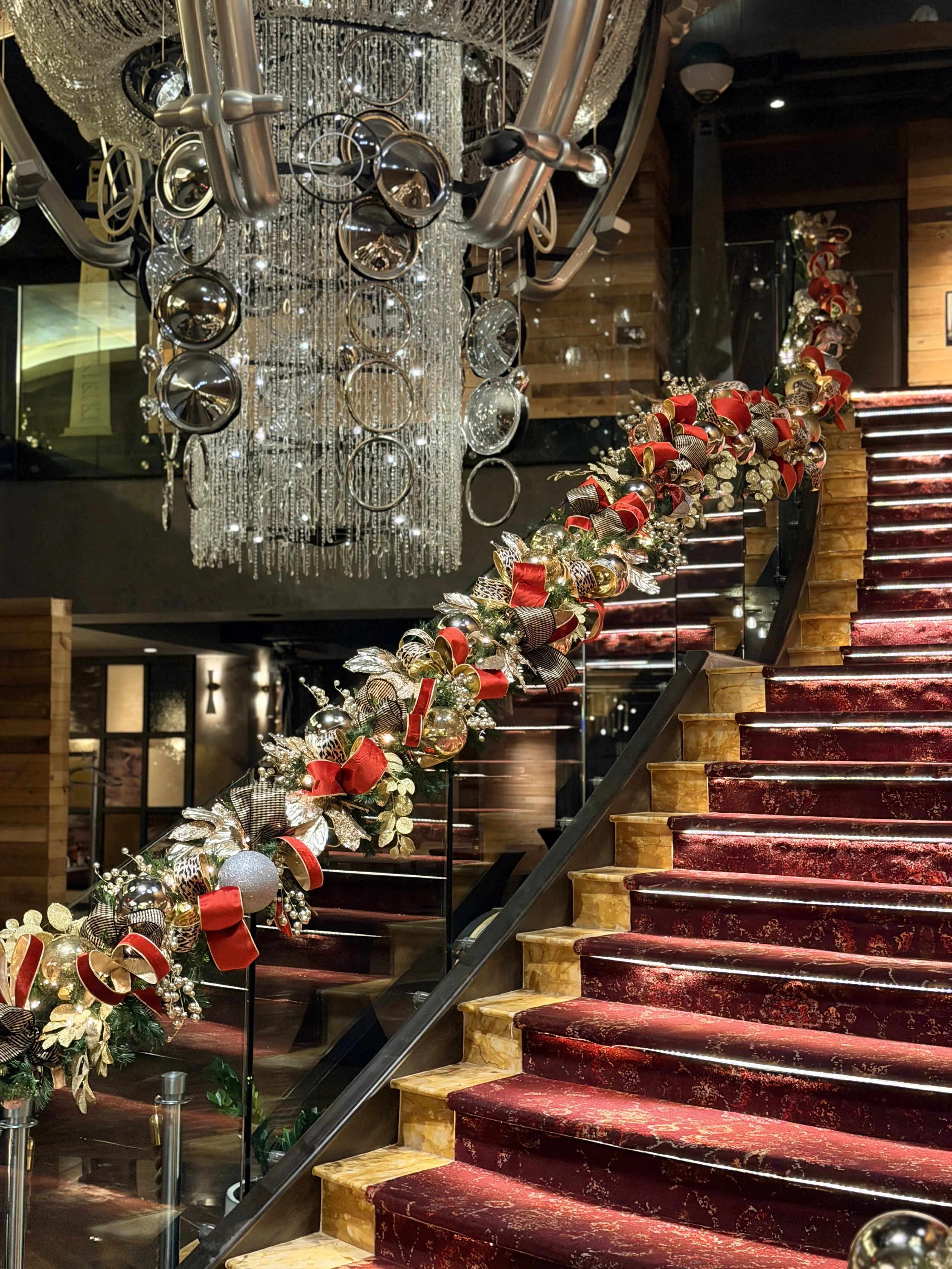
The Nash Hotel Grand Staircase
What actually drives the cost of commercial holiday décor?
Two projects with the exact same number of Christmas trees can have dramatically different budgets.
Here are some of the biggest factors.
Scale
A 12-foot hotel lobby tree is a very different production from a 7-foot tree in a restaurant.
Ceiling heights, tree size, linear footage of greenery, exterior architecture, and the number of spaces all affect both material and labor.
Installation complexity
Can our crew walk into the space at 9 a.m. and install?
Or are we working overnight, using lifts, coordinating loading docks, navigating elevators, working around hotel guests, protecting flooring, and installing overhead elements twenty feet in the air?
The behind-the-scenes logistics are a major part of commercial holiday work.
Product and materials
Commercial-grade greenery, lighting, ornaments, ribbon and specialty décor are designed to withstand significantly more use than residential products.
Custom colors, premium ribbon, oversized ornaments, specialty lighting, or unusual decorative materials can also change the investment.
Custom fabrication
The minute we start building something specifically for a property — signage, scenic pieces, branded ornaments, architectural structures, photo moments, custom props — we move beyond traditional holiday decorating.
That customization can also be what makes an installation unforgettable.
Installation, removal and storage
Holiday décor has an entire lifecycle.
It has to be sourced, prepared, transported, installed, maintained, removed, organized and stored.
For many of our hospitality clients, the appeal of a full-service holiday program is that their team does not have to manage any of that.
What is the difference between a $10,000 holiday installation and a $25,000 one?
This is probably the most useful way to think about holiday budgets.
A $10,000 program can still be beautiful.
We might concentrate that investment on a strong entrance and lobby tree, for example, and create two genuinely memorable guest moments.
At $25,000, we can begin layering the experience.
Maybe the lobby has the hero installation, but the design also extends through check-in, into the restaurant, across architectural railings, and into another guest-facing space.
There may also be room for larger-scale greenery, more sophisticated lighting, overhead elements, custom details, or fabricated pieces.
The difference isn’t necessarily “more stuff.”
It is usually more depth, more scale, more spaces and more customization.
And in many cases, that’s a better goal than simply filling every available surface with Christmas décor.
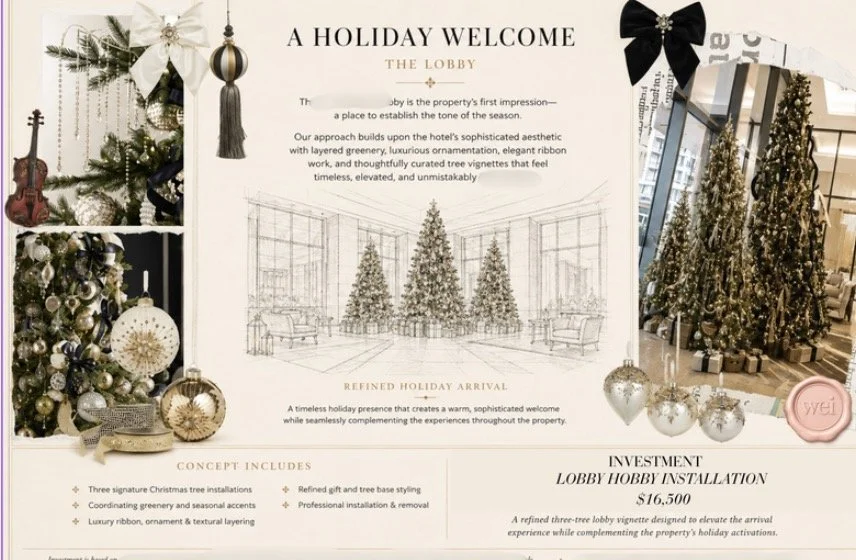
Commercial holiday decor concept rendering for luxury hotel entrance
Where should you spend first if your holiday budget is limited?
When we walk a property, we usually think about the guest journey first.
If the budget can’t cover everything, we prioritize approximately like this:
1. Arrival
What does the guest see before they even walk through the door?
An exterior tree, lit greenery, oversized wreath, or beautifully styled entrance can immediately signal that something special is happening inside.
2. The hero moment
This is usually the lobby, major tree, staircase, bar, or another architectural focal point.
It’s the place guests photograph.
It’s the image the hotel uses on social media.
It’s what people remember.
3. Guest-facing food and beverage spaces
Restaurants, bars and rooftops can benefit enormously from seasonal design because guests actually spend time there.
These spaces are also natural opportunities for seasonal menus, cocktails, events and programming.
4. Supporting spaces
Once the primary moments are strong, the visual story can extend into corridors, elevators, lounges, event areas and secondary spaces.
You do not need to decorate every square inch.
A handful of intentional moments can often make a property feel far more transformed than dozens of smaller decorations scattered everywhere.
Should you rent, purchase or use a managed holiday program?
There isn’t one right answer.
Purchasing
Purchasing décor can make sense for a property that wants to build a long-term collection and has adequate storage, staff and operational capacity to manage it.
Renting
Rental allows a property to create a holiday experience without purchasing an entire décor collection.
It also makes it easier to change the visual direction over time.
Managed holiday programs
For many hotels and hospitality properties, this is the easiest model.
A managed program can include creative direction, product sourcing, installation, removal, off-site warehousing, maintenance and annual refreshing.
The property’s team gets the holiday experience without inheriting a warehouse full of Christmas trees in January.
And yes — that is a surprisingly important consideration.
When should hotels and businesses start planning holiday décor?
Earlier than most people think.
Spring and summer are ideal for developing concepts, setting budgets and beginning custom sourcing.
By late summer, many hospitality properties are actively making decisions about scope, installation dates, inventory and fabrication.
And once fall arrives, availability — both product and installation schedules — can tighten quickly.
We wrote more about the planning timeline in our guide to planning commercial holiday décor early, but the simple rule is:
If holiday is important to your guest experience, it should be treated like a seasonal design project — not a November decorating task.
The right holiday budget is really about impact
The best holiday installations aren’t necessarily the ones with the most décor.
They’re the ones where every element has a reason to be there.
Sometimes that means one spectacular lobby tree.
Sometimes it’s a fully transformed rooftop.
Sometimes it’s an arrival moment guests see before they ever walk through the door.
Our job is to figure out where the design will have the greatest impact — visually, operationally and experientially — and build the holiday program from there.
Planning Holiday 2026?
Whitney Elaine Interiors designs and installs holiday environments for hotels, restaurants, hospitality brands, commercial properties and entertainment spaces.
From focused seasonal moments to full-property holiday programs and immersive activations, we handle creative direction, sourcing, installation, removal and ongoing seasonal support.
Ready to start planning?